
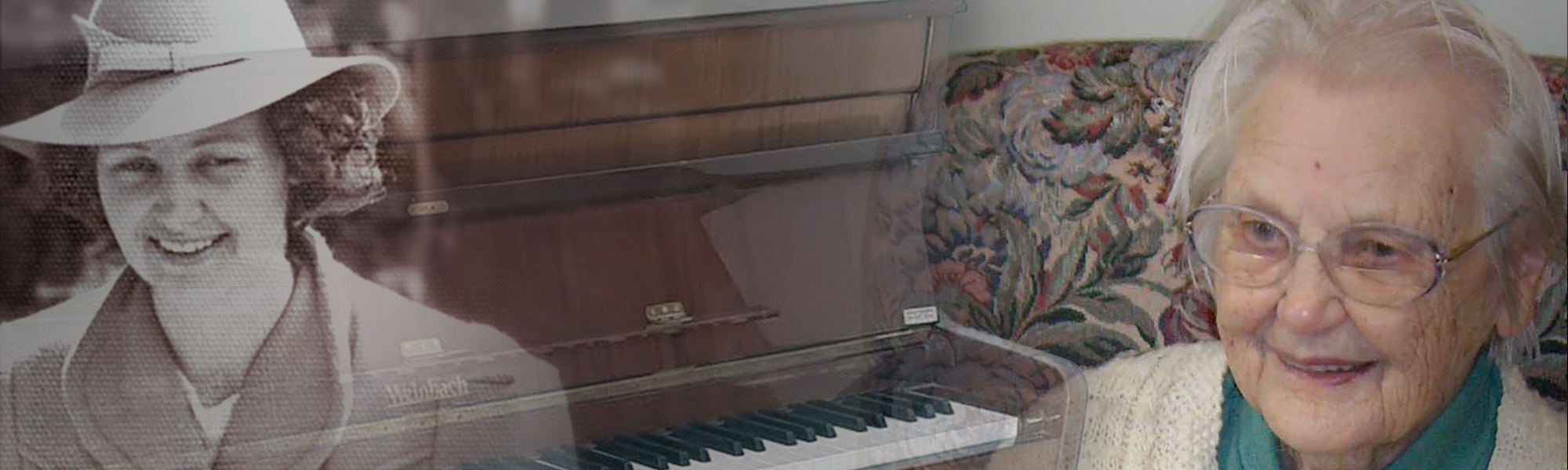
Mum was born in August 1914 in Ballan, a small country town between Geelong and Melbourne. She was the youngest in a big family of seven children.
Her father Edward Whale was the son of a man who came to Australia mid 1800 with a job lined up on the farms in South Australia. Her mother Mary Whale was born Mary Pengelly the daughter of Cornish miner John Pengelly who came to Australia to work In a copper mine in Peak Downs, North Queensland.
Both Edward and John were drawn to the Ballarat region when gold was found close by. I don’t think either of them ‘struck gold’.
Edward was making a living as a market gardener at the time mum was born.
1914 was the start of World War One and three of mum’s uncles went off to fight in the AIF (Allied Infantry Forces). Only two came back, the youngest, Alfred Pengelly, was killed in action at the Battle of Fromelles in 1916.
Mum went to school in Ballan and for a while in Geelong when they bought a cottage in Autumn Street Geelong. She left school at fourteen to look after her mother who was struggling with her mental health after the death of her youngest son. Mum remembers her mother disappearing sometimes and coming back days later. Mum distinctly remembers one day sitting on the kerb outside their home when her mother came back in a horse and cart.
Grandpa Whale was a very caring father of seven children with the typical attitude of the time about women in the work-force. He didn’t want mum working outside of the home so he paid for her to have piano lessons and she was eventually qualified enough to teach students herself so he bought her a piano so that she could teach from home. She did attempt to teach us while we were growing up with very mixed success. My ‘piece de resistance’ was ‘chopsticks,’ in fact it was the only thing I could play. We would encourage mum to play a piece called ‘The burning of Rome’ so that one of us could put a foot under the piano and press the loud pedal hard down. The piano is still in the family, my brother Graeme has it in Tasmania. He also has her ‘shingle’, the board with Miss Emily Whale shown on it as ‘teacher of pianoforte’, which would hang outside mum’s family home in Autumn Street.
Mum’s family weren’t associated with any particular religious denomination but mum and her sisters went to a local church mainly for the social aspect and so mum met dad at a function for young people at the Geelong Town Hall. According to family legend, they sat next to each other and dad was ‘smitten’.
They ‘became a couple’ after a suitable courting time on dad’s part and married in Geelong in 1938. Gwen, David and I were born there in Belmont.
Dad had always wanted to farm so when I was about 5 years old, he bought a small property at a place called Wattle Flat just outside of Ballarat. It was potato growing country so dad cleared the 30 acres and then planted spuds, with our help. By ‘clearing’ I mean burning off the furze, a very prickly weed which covered the land. Naturally the fire got out of hand and dad managed to start a bushfire, fire brigades and all. Quite exciting for us kids. He made up for it by joining the volunteer fire brigade and helping to put out other fires.
Dad and mum built their home at Wattle Flat from the ground up and it was probably the toughest part of mum’s life, sheer exhausting labour. Mum came from tough stock but even so it took a toll on her health. Dad was earning a meagre wage as a delivery man for a nearby country store so we ‘made do’. Mum would make what I thought was an amazing meal of rabbit stew out of the rabbits which dad caught in his rabbit traps.
They moved back to Geelong in 1952 when I was almost 10 and dad went back to working at a woollen mill as a foreman. Mum did a bit of volunteer work there as a first-aid lady but was never on the payroll. She still played the piano a lot and we would have memorable times standing around her singing mostly old-time music very loudly.
Dad was very involved in the local church activities and mum would sometimes play the organ or the piano if needed and was often the hostess when a visiting preacher came to deliver a sermon on a Sunday. Sunday roast was her specialty.
We all eventually left home which I think mum found very hard to cope with so it was important to keep in touch.
Dad died in 1996 and mum was left totally alone. She managed for a while by visiting family often. Eventually she found a place in an aged care facility but I don’t think it was ideal for her, she never seemed to be very happy when we visited. As she aged, her eyesight deteriorated due to macular degeneration and she eventually almost lost her eyesight.
Mum died in December 2009, one of the pioneering stock I always thought. Vale mum!
Written by Emily”s daughter, Win
Mum loved playing Black and White Rag by Winifred Atwell. We would gather around her as she played, and I would eagerly press the loud pedal so the music filled the room. Those moments brought us so much joy, and they remain among my most treasured childhood memories.
~ Emily’s daughter, Win